Fear, Faith and the Humility of Remembering
“I believe in God’s providence and divine appointments,” said Bob Daly, an elder at Tahoe Community Church in Stateline, Nevada.
Three days after acknowledging that he could not understand why fear prevented some people from moving forward, Daly went for an ordinary swim in Lake Tahoe. He came out of the water barely able to speak.
Daly was spending the day with family at Pope Beach when he left their boat and began swimming toward the marked area near shore. It was a familiar routine: swim in, cool off and return to the boat.
About 35 yards from shore, something struck his foot.
He stopped and looked behind him.
“It was a cute little Disney moment,” Daly said of seeing a river otter in the water. “Aw, ain’t that cute. It wasn’t cute for very long.”
The otter submerged and charged his feet and legs.
“It would pop up, get its bearings about six to eight feet away, look at me, dive under, and come for me again,” Daly said.
Trying to keep the animal in sight forced Daly into an awkward vertical position. He screamed for help while the otter surfaced, submerged and attacked again. Daly counted eight strikes around his legs and ankles. During the final one, the animal closed its jaws around his right big toe.
“My adrenaline was almost making me drown,” Daly said. “I was gripped with such tremendous fear I have never felt in my whole life. It didn’t just end; it wasn’t like a quick startle. It went on for four to five minutes, felt like 20.”
By the time Daly could touch the lakebed, he was approximately 12 feet from shore. A boater and a jet skier entered the swim zone, and the otter stopped its pursuit. Daly does not know whether he had moved beyond the animal’s territory or whether the approaching watercraft frightened it away.
“When I reached the shore, I couldn’t even speak. I could barely breathe,” he said.
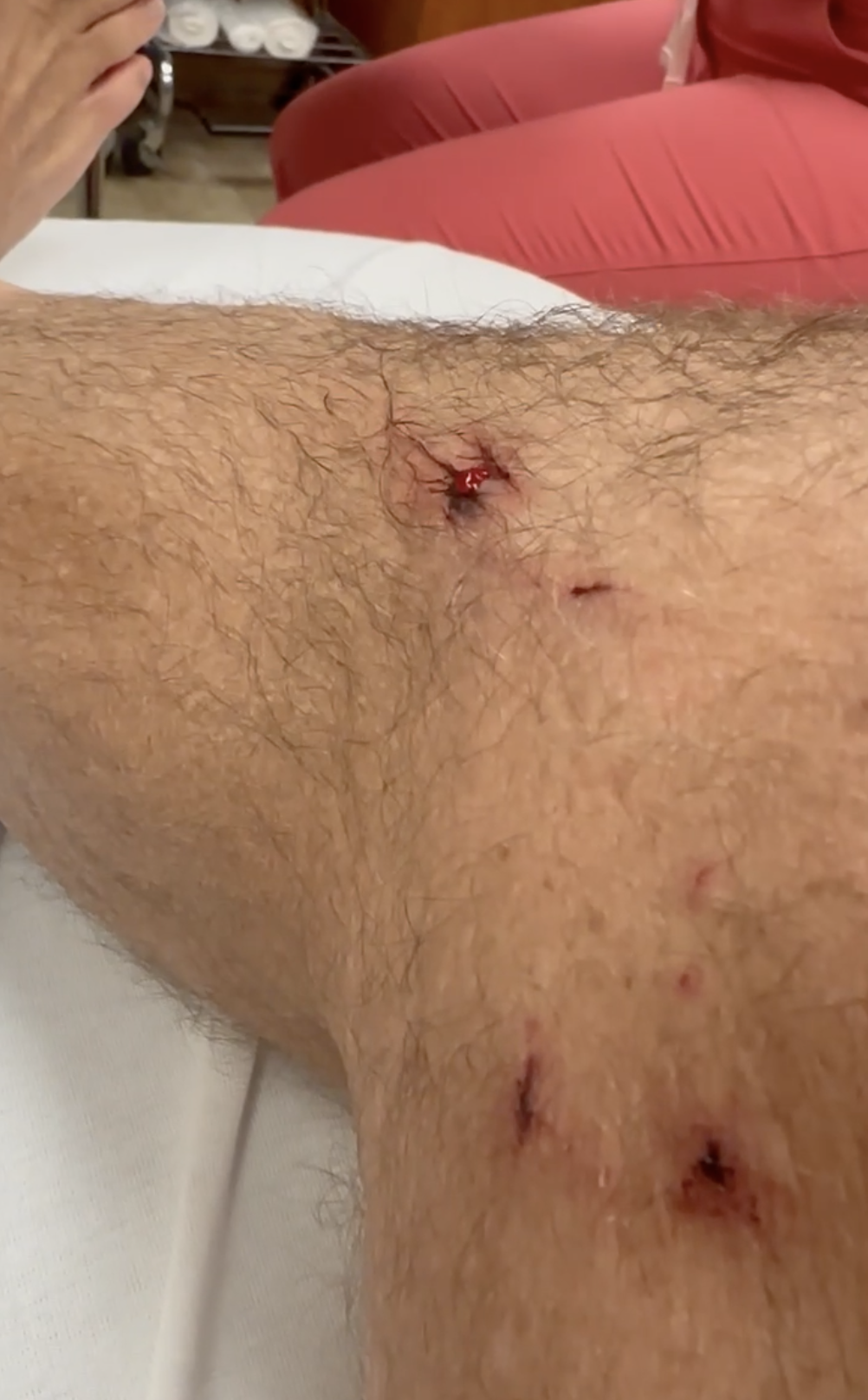
At Barton Health, Daly received emergency treatment for eight bloody bite and scratch marks and began a series of rabies vaccinations. The wounds were not life-threatening. Their emotional and spiritual effects followed him home.
“Why would God let that otter attack me?” he asked.
The question carried added weight because of a conversation Daly had three days before the encounter. He had listened to another believer describe overcoming fear and admitted that his response had been facetious. Daly could not understand why fear kept people from taking action. In retrospect, he said, his confidence had become arrogance.
Three days later, fear was no longer an idea from someone else’s testimony. Daly felt it in the water.
The threat was immediate. Something he could not see was moving beneath him and attacking his body. His nervous system responded before he had time to interpret the experience.
Fear is not exclusively a failure of faith or a weakness of character. The amygdala participates in a larger network that detects possible threats, directs attention and prepares the body to respond. Describing it as a single “fear center” obscures the complexity of those processes (Öhman, 2005).
Daly did not choose the first rush of adrenaline. He still had choices to make while it moved through him.
That distinction matters. A person can experience fear without surrendering every subsequent decision to it. Someone who has spent years learning to act while afraid may eventually forget that courage had to be learned.
The brain’s capacity to change through experience is called neuroplasticity. Fear responses can be shaped by experience, and new learning can alter how a person responds to a familiar threat. That does not mean fear can always be overcome by willpower, nor does it justify judging someone whose body reacts differently. The research instead supports a more patient conclusion: human responses are learned within complicated biological systems, and those systems remain capable of change.
Neuroplasticity does not prove a theological claim. It does, however, leave room for growth. Christians may recognize that possibility as compatible with grace, while remaining honest about the boundary between scientific evidence and faith.
Prayer is not an abstract exercise for Daly. It is part of a relationship through which he seeks direction, meaning and nearness to God.
Researchers sometimes use the term neurotheology to describe the study of relationships between brain function and religious experience. The field can examine measurable activity associated with prayer. It cannot determine whether God is listening or whether a particular event was divinely arranged.
In an fMRI study of highly religious Christians, improvised personal prayer engaged regions associated with social cognition. The researchers suggested that participants experienced personal prayer in ways that were neurologically comparable, in some respects, to interpersonal interaction (Schjoedt et al., 2009).
Those findings do not establish that prayer made Daly fearless or that the attack made him more empathetic. Daly’s interpretation comes from his faith and from what he recognized in himself afterward.
He had been accustomed to moving through fear. That experience may have made it difficult for him to remember how overpowering fear can feel to someone else. The attack placed him inside the response he had struggled to understand.
Another person’s nervous system was never his to judge. Grace required him to admit that.
Scripture repeatedly tells believers not to fear, yet it is also filled with faithful people who experienced fear. David does not say, “If I am afraid.” He says, “When I am afraid, I put my trust in you” (Psalm 56:3).
The presence of fear is not, by itself, evidence of failed faith. David’s words assume fear may come. They direct attention toward what a person does when it arrives.
Proverbs 3:5–6 offers similar instruction:
“Trust in the Lord with all your heart;
do not depend on your own understanding.
Seek his will in all you do,
and he will show you which path to take” (NLT).
Trust does not require denying that danger exists. If Daly encounters an angry otter again, he does not plan to remain motionless in the lake to demonstrate his faith.
“I’d swim like Michael Phelps,” he said.
The answer is funny because it is practical. Daly can trust God and swim toward shore. Wisdom, action and faith do not have to compete.
Scripture’s instruction not to fear is different from a promise that a believer’s body will never produce fear. Faith becomes visible in where someone turns when fear arrives. Courage has meaning because the danger feels real.
A story like Daly’s creates a theological temptation. It would be easy to declare that God sent an otter into Lake Tahoe to punish one man’s pride. Daly’s experience does not provide enough evidence to make that claim.
Science can describe parts of the physical event. An animal attacked a swimmer. Daly’s threat-response systems activated. His body released the energy needed to escape. Science cannot determine whether the timing carried divine meaning.
Scripture teaches Christians to trust God’s sovereignty and believe that suffering can be redeemed. It does not give believers access to God’s hidden purpose behind every injury, accident or frightening encounter.
Daly can believe that God used the experience without claiming to know why the otter attacked him. Grace does not require a tidy explanation. It allows a frightening experience to become an occasion for humility, compassion and change without pretending every question has been answered.
The more useful question may be what God can do with what happened.
Three days after struggling to understand another person’s fear, Daly encountered fear in the deep water of Lake Tahoe. He entered the lake confident in his fearlessness and came out barely able to speak. The experience did not give him a complete theology of suffering. It gave him a clearer view of another person’s struggle.
Natural animal behavior can explain what occurred in the water. Daly’s faith shapes what he believes can grow from it. Those explanations do not have to cancel each other.
“I believe in God’s providence and divine appointments,” Daly said.
Divine appointments do not always announce themselves.
Sometimes they have teeth.
References
Öhman, A. (2005). The role of the amygdala in human fear: Automatic detection of threat. Psychoneuroendocrinology, 30(10), 953–958. https://pubmed.ncbi.nlm.nih.gov/15963650/
Carvour, H. M., Radke, A. K., & French, N. S. (2025). A review of the neuroscience of religion: An overview of the field, its limitations, and future questions. Frontiers in Neuroscience, 19, 1587794. https://doi.org/10.3389/fnins.2025.1587794
Schjoedt, U., Stødkilde-Jørgensen, H., Geertz, A. W., & Roepstorff, A. (2009). Highly religious participants recruit areas of social cognition in personal prayer. Social Cognitive and Affective Neuroscience, 4(2), 199–207. https://doi.org/10.1093/scan/nsn050
Haverkamp, E., Olsman, E., Ćurčić-Blake, B., Vila Ramírez, V., Aleman, A., Ket, J. C. F., & Schaap-Jonker, H. (2025). The convergent neuroscience of Christian prayer and attachment relationships in the context of mental health: A systematic review. Frontiers in Psychology, 16, 1569514. https://doi.org/10.3389/fpsyg.2025.1569514
Chin, F., Chou, R., Waqas, M., Vakharia, K., Rai, H., Levy, E., & Holmes, D. (2021). Efficacy of prayer in inducing immediate physiological changes: A systematic analysis of objective experiments. Journal of Complementary and Integrative Medicine, 18(4), 679–684. https://doi.org/10.1515/jcim-2020-0075
Baten, M. A. C., Keller, A. S., Miller, C. H., & Sacchet, M. D. (2026). The functional neuroimaging of meditation: A quantitative whole-brain meta-analysis and systematic review. Neuroscience & Biobehavioral Reviews, 186, 106709. https://doi.org/10.1016/j.neubiorev.2026.106709
Fox, K. C. R., Dixon, M. L., Nijeboer, S., Girn, M., Floman, J. L., Lifshitz, M., Ellamil, M., Sedlmeier, P., & Christoff, K. (2016). Functional neuroanatomy of meditation: A review and meta-analysis of 78 functional neuroimaging investigations. Neuroscience & Biobehavioral Reviews, 65, 208–228. https://doi.org/10.1016/j.neubiorev.2016.03.021